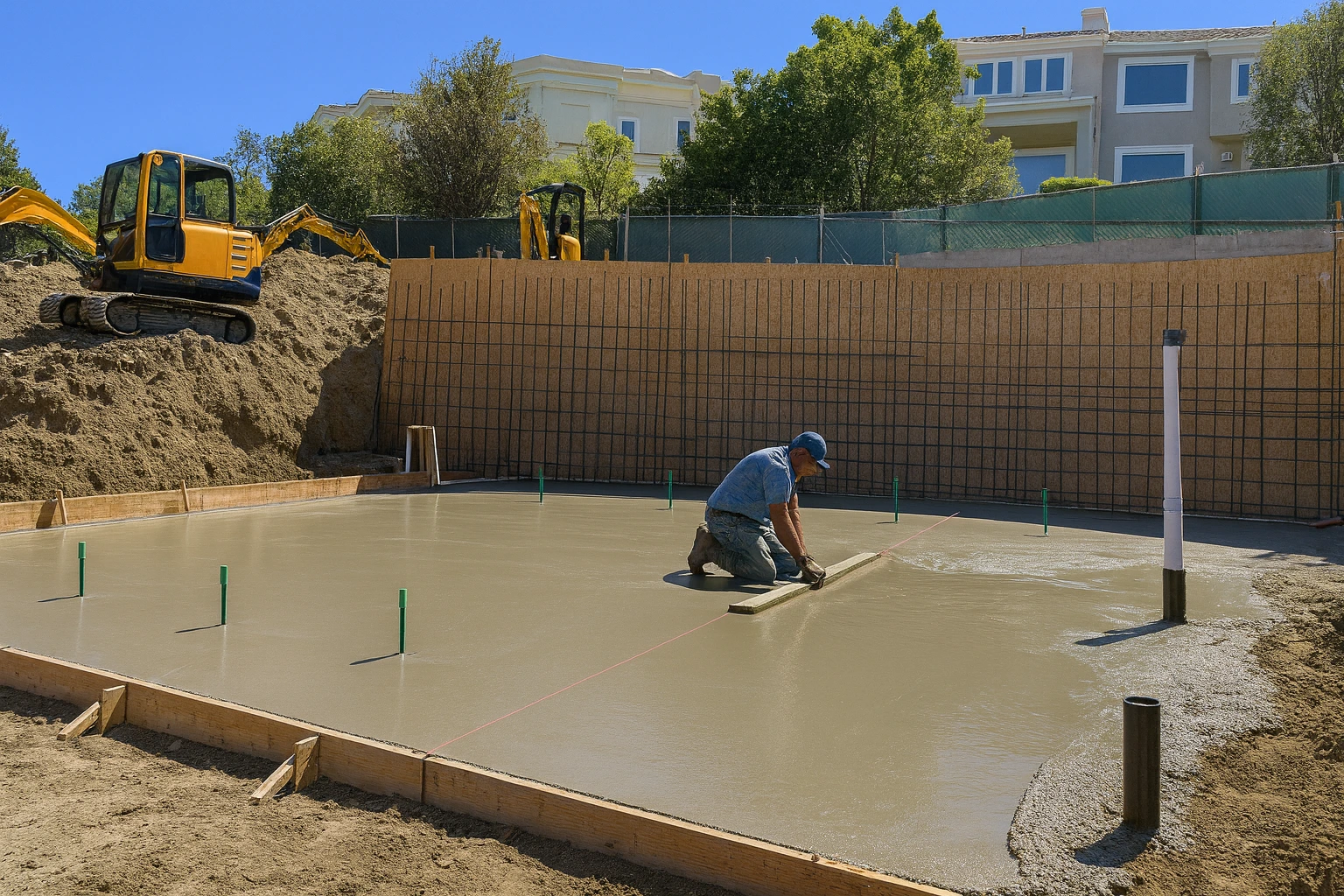
A properly engineered slab foundation is the key to a strong, stable luxury home. In Los Angeles we design slab foundations to account for soil conditions, drainage, seismic loads and long-term durability, creating a reliable base for custom residences and commercial spaces.
What Is a Slab Foundation?
A slab foundation is a thick, reinforced concrete pad that forms the base of a building. It can be a simple monolithic slab, a thickened-edge slab, a conventional slab with footings or a structural mat slab for heavier or more complex projects. On Los Angeles luxury homes and commercial designs, the slab is engineered to work with local soils, grade, and seismic demands — not against them.
While it looks straightforward once it is poured, a good slab foundation represents careful planning: soils testing, drainage design, rebar layout, plumbing coordination and inspection all happen long before concrete trucks show up on site.
Soil Conditions & Geotechnical Reports
The starting point for any serious slab foundation is the soil report. Los Angeles and the surrounding areas include everything from sandy soils to expansive clays and hillside lots. On R Builders projects we:
- Engage a geotechnical engineer to evaluate existing soils and provide a written report.
- Determine allowable bearing capacity, expansion index and required overexcavation and recompaction.
- Review recommendations for slab type, thickness, reinforcement and subgrade preparation.
Cutting corners on the soils and engineering phase can lead to slab movement, cracking and long-term structural problems. That is why we treat the recommendations in the soils report as a roadmap, not a suggestion.
Drainage, Grading & Moisture Management
Even a perfectly engineered slab will struggle if water is constantly collecting under or around it. Proper drainage is non-negotiable, especially for luxury homes and commercial spaces with sensitive finishes and equipment.
On a typical project we consider:
- Site grading: Sloping finished grade away from the structure to keep water moving.
- Perimeter drains: Using footing drains or French drains where recommended by the engineer.
- Downspouts & gutters: Routing roof water away from the slab, not dumping it at the foundation line.
- Flatwork coordination: Making sure patios, walkways and driveways don’t trap water against the building.
These details are especially important on commercial design-build projects where heavy foot traffic and outdoor spaces interface directly with the slab edge.
Vapor Barriers, Insulation & Sub-Slab Prep
Under the slab, we focus on controlling moisture and providing a stable base for the concrete. Typical elements can include:
- Compacted base material to the depth specified in the soils report.
- A vapor barrier or vapor retarder to reduce moisture migration into the building.
- Rigid insulation in certain high-performance or conditioned slab applications.
- Careful protection of the vapor barrier during rebar placement and plumbing work.
For commercial kitchens, restaurants and certain luxury residential spaces, controlling vapor and moisture is critical for finish performance and indoor air quality.
Reinforcement: Rebar, Post-Tension & Mat Slabs
The “skeleton” of a slab foundation is its reinforcement. Depending on project type and engineering, R Builders works with several common systems:
- Conventional rebar slabs: Steel bar reinforcement placed in a grid, with additional bars at beams and thickened areas.
- Post-tensioned slabs: Cables tensioned after the concrete cures to help resist cracking and soil movement.
- Mat slabs: Thick, heavily reinforced slabs used where soils are challenging or loads are high.
We coordinate closely with structural engineers and inspectors to ensure bar sizes, spacing and cover meet the stamped plans and applicable codes.
Plumbing, Conduits & Slab Penetrations
Many of the systems that make a building functional — plumbing, electrical conduits, sleeves for future utilities — pass through the slab. These must be laid out correctly before the pour:
- Under-slab plumbing for bathrooms, kitchens and mechanical rooms.
- Sleeves for gas lines, electrical feeders and low-voltage conduits.
- Floor drains for commercial spaces, garages and certain residential applications.
On design-build projects, our team double-checks locations against architectural plans and interior layouts so a missed or misplaced penetration doesn’t delay construction later.
Concrete Placement, Curing & Flatness
On pour day, execution matters. We work with experienced concrete crews to:
- Verify mix design, slump and any admixtures match the engineer’s specifications.
- Place and consolidate the concrete to avoid voids around rebar and penetrations.
- Strike off and finish the slab for the required flatness and levelness, especially under large-format tile and polished concrete.
- Manage curing — using methods such as wet curing or curing compounds as appropriate.
For commercial design projects, we often coordinate slab tolerances with equipment suppliers, casework, and industrial flooring requirements.
Seismic Design for Los Angeles
Building in a seismic zone means foundations must work as part of an integrated lateral system. For slab foundations this can include:
- Anchor bolts and holdowns embedded in the slab or perimeter footings.
- Thickened edges and grade beams that tie into shear walls and moment frames.
- Special detailing at re-entrant corners, step-downs and slab transitions.
Our job is to ensure the foundation details shown on the plans are actually executed in the field — with the right hardware, layout and inspections at each step.
Common Slab Foundation Issues & How We Avoid Them
Many of the common slab foundation problems people hear about — cracking, settlement, moisture issues — trace back to missing steps in the early phases of the project. To minimize risk, R Builders focuses on:
- Following soils and engineering recommendations instead of “rule of thumb.”
- Controlling drainage and site water from day one.
- Verifying reinforcement and penetrations before every pour.
- Documenting inspections, tests and concrete tickets for the project record.
No foundation is completely immune to time and the environment, but a well-designed and well-built slab significantly reduces long-term issues.
When a Slab Foundation Makes Sense
Slab foundations are a strong option for many Los Angeles luxury homes and commercial spaces, especially when:
- The site is relatively flat and has appropriate soils.
- You want minimal steps and a clean indoor-outdoor transition.
- Floor finishes such as polished concrete, large-format tile or LVP will be installed directly over the slab.
- Equipment loads or occupancy type call for a robust, continuous foundation system.
In some cases, raised foundations or hybrid systems are a better fit — which is why we evaluate foundation type early in the design-build process.
Planning a Project in Los Angeles?
If you are considering a new commercial space, luxury home or ADU in Los Angeles, the slab foundation deserves careful attention. It is the base that everything else sits on — structure, finishes and long-term value.
Call R Builders, Inc. at 1 (800) 520-5008 or visit our consultation form to schedule a consultation about your foundation and structural design needs.
Disclaimer: This article is for general informational purposes only and does not replace project-specific engineering, soils reports or professional advice. Always consult with licensed engineers, geotechnical experts and local building officials for your specific project.